


Why Some Websites Rank Faster Than Others Even With Less Content

 Jun 24,2026
  By Waistra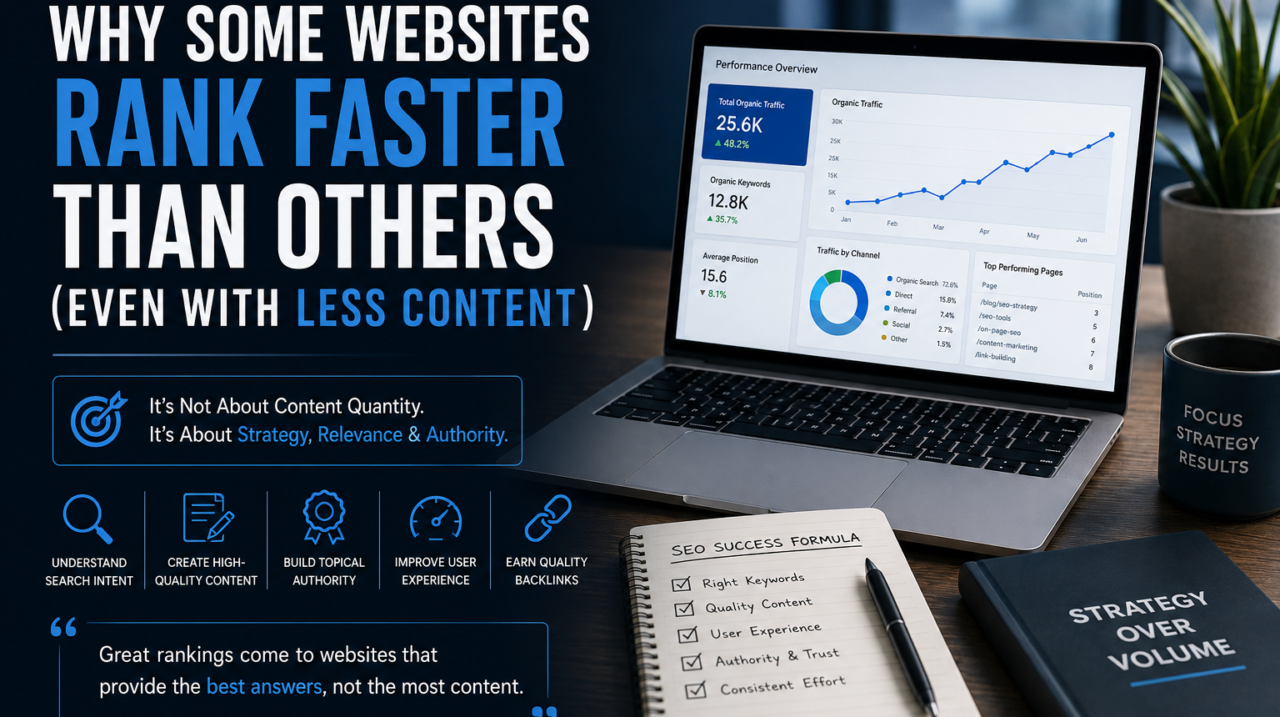
One of the most frustrating experiences for website owners, marketers, and business leaders is investing months into content creation only to discover that a competitor with fewer pages is ranking higher on Google.
You’ve probably seen it happen.
Your website may have hundreds of blog posts, detailed service pages, and a steady publishing schedule. Meanwhile, another website with a fraction of your content appears on the first page of search results, attracts more organic traffic, and generates more leads.
At first glance, it doesn’t make sense.
Shouldn’t more content lead to better rankings?
Not necessarily.
The truth is that modern SEO has evolved significantly. Search engines have become far more sophisticated, and the factors that influence rankings today are very different from what worked a decade ago. Businesses that understand these changes are able to rank faster, generate more organic traffic, and build stronger online visibility even when they publish less content.
The Evolution of Search Engine Optimization
There was a time when SEO was largely driven by volume. Websites could publish dozens of articles targeting slight variations of the same keyword and achieve impressive rankings. The focus was often on producing as much content as possible and acquiring large numbers of backlinks.
Today, search engines are designed to evaluate quality, relevance, authority, and user satisfaction.
Google’s goal is simple: provide users with the best possible answer to their search query.
As a result, websites that focus on delivering genuine value often outperform websites that focus only on publishing more pages.
This shift has transformed the way successful businesses approach content marketing and search engine optimization.
Why Content Quantity Alone Doesn’t Work
Many organizations still operate under the assumption that more content automatically means more traffic.
While publishing regularly remains important, quantity without strategy rarely delivers meaningful results.
Consider two different websites.
The first publishes fifty average-quality articles every month. Most of these articles cover broad topics, provide generic information, and offer little unique value.
The second publishes five in-depth articles that answer specific questions, provide practical insights, and address real user challenges.
Which website is more likely to earn backlinks, engage readers, and satisfy search intent?
In most cases, it will be the second one.
Search engines increasingly prioritize content that demonstrates expertise, depth, and usefulness. A smaller collection of highly valuable content can outperform a massive library of average content because it creates a better experience for users.
Search Intent: The Factor That Separates Winners From Everyone Else
One of the most overlooked aspects of SEO is search intent.
Every keyword represents a specific goal. People search because they want information, solutions, products, services, or guidance.
The websites that rank fastest understand this concept deeply.
Instead of asking, “Which keywords should we target?” they ask, “What is the user trying to achieve?”
For example, a keyword such as “project management software” may attract a wide range of users with different intentions.
Some users may be researching options.
Some may be comparing vendors.
Others may be ready to make a purchase.
Creating content that aligns with these intentions dramatically increases the likelihood of ranking well.
When content matches user expectations, engagement improves. Visitors stay longer, interact more with the website, and are more likely to continue exploring additional pages. These positive signals help reinforce search visibility over time.
The Growing Importance of User Experience
SEO is no longer confined to keywords, title tags, and backlinks.
User experience has become a major competitive advantage.
When someone clicks on a search result, their experience begins immediately. They expect pages to load quickly, content to be easy to read, and navigation to be intuitive.
If these expectations are not met, visitors leave.
Search engines pay attention to these behaviors because they provide insight into content quality and user satisfaction.
Several user experience factors contribute to better SEO performance:
Page Speed
Users expect websites to load quickly. Even a few seconds of delay can increase bounce rates and reduce engagement.
Mobile Optimization
With the majority of searches occurring on mobile devices, responsive design is no longer optional. Websites that deliver seamless mobile experiences often have a significant advantage.
Readability
Well-structured content with clear headings, logical flow, and easy-to-understand language keeps users engaged and encourages deeper exploration.
Navigation
Visitors should be able to find information quickly. Clear menus, internal links, and intuitive page structures contribute to a better overall experience.
Businesses that invest in these areas often see improvements not only in rankings but also in lead generation and conversion rates.
Authority Is the Hidden Ranking Accelerator
When two websites publish content on the same topic, authority often determines which one ranks higher.
Authority is not something that can be purchased or manufactured overnight. It is earned through consistent effort and valuable contributions over time.
Search engines evaluate authority using numerous signals, including:
- Quality backlinks from reputable websites
- Industry expertise
- Content depth and accuracy
- Brand recognition
- User engagement
- Consistent publication of valuable resources
A website with strong authority can often rank new content much faster than a newer or less established competitor.
This is why businesses that invest in thought leadership, educational content, and industry expertise frequently experience stronger long-term SEO performance.
The Strategic Role of Internal Linking
One of the most underestimated SEO techniques is internal linking.
Many websites create valuable content but fail to connect related pages effectively.
Internal links help search engines understand relationships between topics while guiding users toward additional relevant information.
A strong internal linking strategy can:
- Improve content discoverability
- Distribute authority across pages
- Increase session duration
- Reduce bounce rates
- Strengthen topic relevance
When implemented correctly, internal linking creates a more connected website ecosystem that benefits both users and search engines.
Why Topical Authority Matters More Than Ever
Modern SEO increasingly rewards topical authority.
Instead of publishing content on dozens of unrelated subjects, successful websites build comprehensive coverage around specific themes.
For example, a website focused on digital marketing might create interconnected resources covering:
- SEO strategy
- Content marketing
- Link building
- Technical SEO
- Local SEO
- Keyword research
- Website optimization
Over time, this comprehensive coverage signals expertise to search engines.
As authority grows within a topic area, rankings often become easier to achieve across related keywords.
Consistency Beats Short-Term SEO Tactics
Many businesses search for shortcuts.
They look for ranking hacks, algorithm loopholes, or quick wins that promise immediate results.
While these tactics may occasionally produce temporary gains, sustainable SEO growth comes from consistency.
The websites that dominate search results are typically those that have spent years improving content quality, strengthening authority, enhancing user experience, and understanding their audience.
SEO should be viewed as a long-term business asset rather than a short-term marketing tactic.
Each optimized page, each quality backlink, and each valuable piece of content contributes to future growth.
The Real Reason Some Websites Rank Faster
When we analyze websites that consistently achieve strong rankings, a common pattern emerges.
They are not necessarily producing the most content.
They are producing the most relevant content.
They understand their audience better.
They solve problems more effectively.
They create better user experiences.
They build authority consistently.
And they focus on long-term value instead of short-term gains.
The next time you see a competitor ranking above you despite having fewer pages, don’t assume they have discovered a secret SEO trick.
More often than not, they have simply aligned their strategy more closely with what search engines and users actually want.
In today’s digital landscape, ranking success is determined by relevance, authority, user experience, and trust—not by content volume alone.
Businesses that focus on creating genuinely useful resources, understanding search intent, and delivering exceptional experiences will continue to outperform competitors regardless of how much content those competitors publish.
The future of SEO belongs to websites that prioritize value over volume, quality over quantity, and strategy over shortcuts.


 Jun 22, 2026
